


A First-Ever National Count
For the first time, the National Crime Records Bureau (NCRB) has put an official number on crimes committed against animals in India. For decades, national crime data tracked dog bites, animal attacks, and human-wildlife conflict, but crimes committed against animals had no dedicated national count at all. That changed this year.
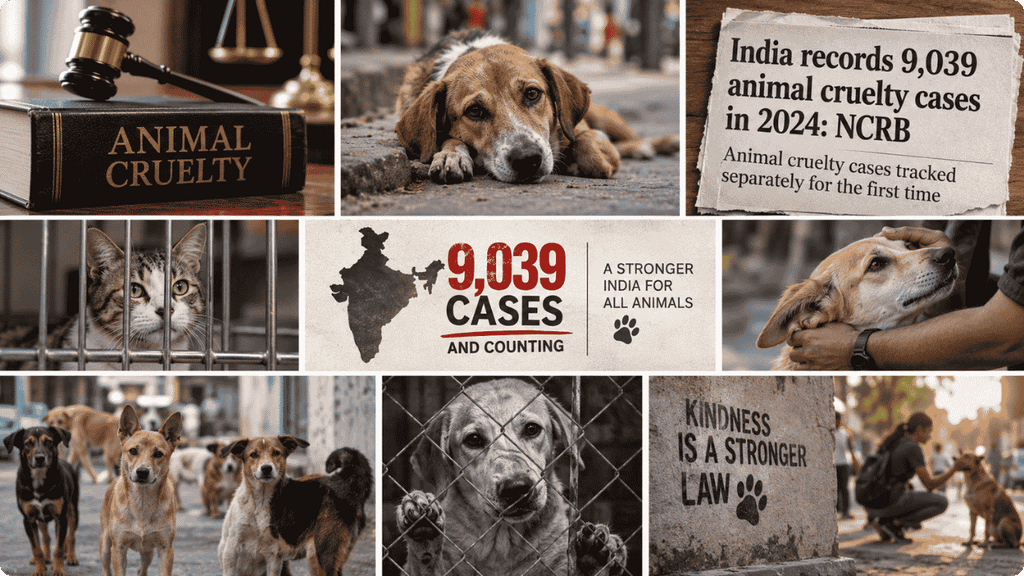
The NCRB’s Crime in India 2024 report, released in May 2026, is the first edition to record cases registered under the Prevention of Cruelty to Animals (PCA) Act, 1960, as a distinct, separately tracked category. The national total for 2024 stands at 9,039 registered cases.
Legal commentators tracking the release have called it a genuine milestone in Indian crime reporting. As one analysis on the subject put it, the absence of a dedicated cruelty category for over three decades meant that, statistically speaking, crimes against animals simply did not exist in the country’s official crime record, even as individual cases of neglect, poisoning, and violent abuse surfaced regularly in local news and on social media. The 2024 report closes that specific gap, even if, as this article goes on to examine, it opens up several new questions of its own.
Why It Took This Long
India’s PCA Act has been on the books since 1960, but crimes registered under it were, until now, folded into broader “miscellaneous” crime categories in national data, making it effectively impossible to isolate animal cruelty figures at a national or even state level from official sources alone. Anyone wanting a sense of scale had to rely on scattered RTI (Right to Information) responses, individual state police data where it was voluntarily shared, or aggregated reporting by animal welfare NGOs working city by city.
That data vacuum had real consequences. Without a consolidated national baseline, it was difficult for lawmakers, courts, or advocacy groups to make an evidence-based case for strengthening the PCA Act’s penalties, allocating enforcement resources, or identifying which states most needed intervention. The NCRB’s decision to begin tracking PCA Act cases as their own category in the Crime in India series is, in that sense, as much an administrative and statistical development as a law-and-order one.
Where the Cases Were Reported
The state-by-state breakdown shows a wide spread, with a handful of states accounting for the bulk of registered cases.
| State/UT | Cases Registered (2024) |
|---|---|
| Maharashtra | 2,927 |
| Telangana | 1,890 |
| Kerala | 1,510 |
| Uttar Pradesh | 1,121 |
| Karnataka | 320 |
| Tamil Nadu | 259 |
| Gujarat | 181 |
| Jammu & Kashmir (UT) | 223 |
| Delhi (UT) | 35 |
Maharashtra alone accounts for nearly a third of the national total, close to one in every three cases registered anywhere in the country. Among Union Territories, Jammu and Kashmir recorded the highest count at 223 cases, ahead of Delhi’s 35.
At the other end of the spectrum, five states, Arunachal Pradesh, Mizoram, Nagaland, Sikkim, and Tripura, recorded zero cases for the year. Ladakh, Lakshadweep, and Chandigarh also reported no cases at all.
Arrests, Chargesheets, and Convictions
Beyond the raw case count, the NCRB data also captures how these cases moved through the justice system. A total of 10,312 people were arrested nationally in connection with animal cruelty cases in 2024. The chargesheet rate, the share of cases in which police filed formal charges, stood at 96.7%, and the conviction rate came in at 80.5%. Separately, 147 cases were closed due to insufficient evidence or untraceable leads.
Taken at face value, those chargesheet and conviction figures look unusually strong compared to many other categories of crime in India. Whether that reflects straightforward evidence in cruelty cases, focused prosecution, or some other factor in how these particular cases are processed is not something the topline data explains on its own.
Why the State Numbers Need Careful Reading
On the surface, the state-wise figures might suggest Maharashtra has a dramatically larger animal cruelty problem than, say, Tamil Nadu or Delhi. Animal welfare groups caution strongly against that reading.
The NCRB’s count reflects registered First Information Reports (FIRs), not the actual incidence of cruelty. A state’s number therefore depends heavily on how often complaints reach a police station and how willing that police station is to register them as cases. A high count can just as easily indicate better public reporting and more responsive police stations as it can indicate more cruelty. Conversely, a zero-case state may simply mean cruelty complaints are not being filed or registered there, not that no cruelty is occurring.
Reacting to the release of the data, PETA India described the 9,039 figure as likely representing only a small fraction of the real scale of cruelty in the country, according to WION’s coverage of the report.
The dataset also arrives as a single combined figure rather than a categorized breakdown. It does not distinguish neglect from deliberate abuse, does not separately track organised cruelty such as animal fighting, and does not indicate which species were involved in each case. Without that granularity, it’s difficult for authorities, or the public, to identify precisely where enforcement or awareness efforts are most needed.
The Law Behind the Numbers
The PCA Act, 1960 remains a comparatively weak deterrent on paper. The penalty for a first general offence under the Act can still be a fine as low as ₹50, a figure animal welfare organisations have criticised for years as grossly inadequate. An amendment proposing steeper penalties has been under discussion but has not yet been passed by Parliament.
However, the legal landscape shifted in one important respect in July 2024. Killing, poisoning, maiming, or disabling an animal is now punishable under Section 325 of the Bharatiya Nyaya Sanhita (BNS), which replaced the Indian Penal Code that month. Section 325 carries a jail term of up to five years, a fine, or both, a considerably heavier penalty than anything available under the PCA Act alone. Animal welfare lawyers increasingly advise citizens filing complaints over serious cruelty to cite BNS Section 325 alongside the PCA Act, rather than relying on the PCA Act in isolation.
This two-track legal structure, a weak, decades-old PCA Act sitting alongside a much stronger BNS provision introduced only in mid-2024, means the severity of punishment a cruelty case attracts can depend heavily on which law is invoked at the time of filing, and on whether the complainant or investigating officer is aware that BNS Section 325 is even available as an option. Animal welfare advocates argue this makes public awareness of the BNS provision nearly as important as the provision itself: a five-year jail term is of little deterrent value if complainants and police continue to default to the PCA Act’s older, weaker framework out of habit.
The Long-Pending Case for Stronger PCA Penalties
The proposed amendment to raise PCA Act penalties has been a recurring subject of discussion for years, predating this NCRB data release by a considerable margin. Successive drafts have floated penalties ranging from higher fines to the introduction of jail terms for repeat or particularly severe offences under the Act itself, rather than relying on cruelty cases to qualify for the BNS’s separate, narrower killing-and-maiming provision.
Animal welfare organisations have long argued that a ₹50 fine, unchanged for decades even as inflation has eroded its deterrent value many times over, sends an unintentional signal that cruelty toward animals is a minor regulatory matter rather than a serious offence. With a national dataset now available for the first time, advocates are likely to point to the 9,039-case count, and the underlying uncertainty about how much larger the real number might be, as fresh justification for Parliament to finally act on the pending amendment.
What This First Count Actually Enables
The real significance of this release may lie less in the 2024 numbers themselves and more in what becomes possible going forward. With a baseline now established, the NCRB’s next annual report will allow, for the first time, a year-on-year comparison of state-wise animal cruelty figures. That comparison could start to reveal whether shifts in the numbers reflect genuine changes in reporting and registration behaviour, rather than changes in the underlying scale of cruelty, an important distinction that a single year of data cannot establish on its own.
If You Witness Animal Cruelty
Animal welfare advocates recommend a specific sequence of steps for anyone who witnesses cruelty against an animal:
- Document it. Take photos or videos, noting the date, time, and location, and record details of any witnesses.
- File a police complaint at the nearest station, citing the PCA Act and, for serious injury or killing, BNS Section 325.
- Contact a local animal welfare organisation, which can assist with rescue, veterinary care, and following up on the complaint.
- Seek veterinary care for the animal and retain the veterinary report, which can serve as evidence in any subsequent case.
The Bigger Picture
India’s animal cruelty problem has, until now, been discussed largely through anecdote, viral videos, and scattered state-level reporting rather than a consolidated national dataset. This first NCRB count doesn’t settle the debate over how widespread cruelty actually is, if anything, it underscores how much remains unmeasured, particularly in states reporting zero cases. But it does mark the end of a 34-year gap in which crimes against animals in India had no dedicated national record at all. Whether that changes enforcement outcomes, public reporting behaviour, or the pace of legal reform will likely become clearer only once a second year of comparable data exists.
- Sources: National Crime Records Bureau, Crime in India 2024 (released May 2026), Ministry of Home Affairs, Government of India (ncrb.gov.in); The Tribune; WION
Pets News Network is India’s first dedicated media platform for the pet and animal industry. For breaking global pet news, brand coverage, and advertising enquiries, contact: info@petsnewsnetwork.com