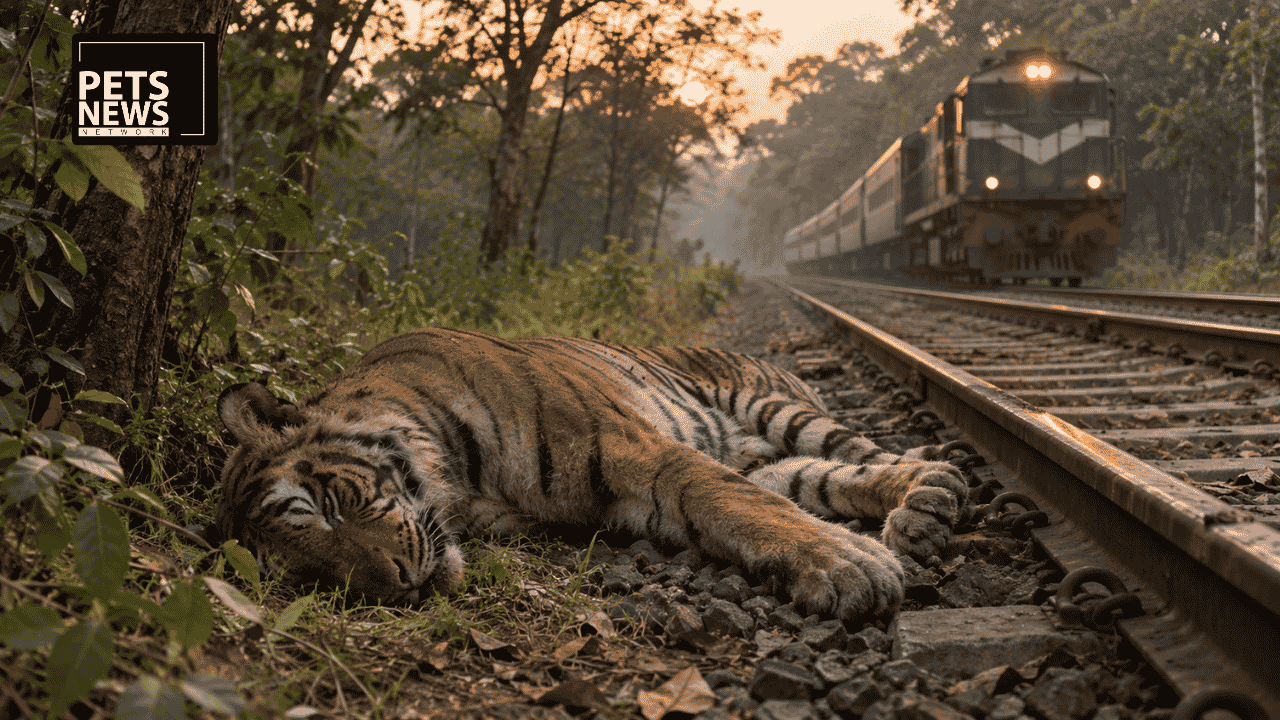

In a fatal Sengottai tiger train collision in Tamil Nadu, a male tiger crossing the railway line was struck by an express train in the early hours of 4 November. It died with devastating head injuries. A subsequent report said preliminary findings indicated that the train dragged the animal roughly 50 metres. The forest department has now asked for the night-time speed limit on the stretch to be halved. That request is a response, not yet an implemented safety measure. The question is whether a rare death will be treated as an isolated accident or as evidence that the route needs a different approach to wildlife crossings.
What happened in the Sengottai tiger train collision
The collision occurred in the early hours of Wednesday, 4 November 2026, on a railway stretch near Bhagavathipuram and Poolankudiyiruppu, close to Sengottai in Tenkasi district and the Kerala border. Reports differ slightly on the precise timing, placing it around the period after midnight and before 3 am; some describe approximately 2:30 am.
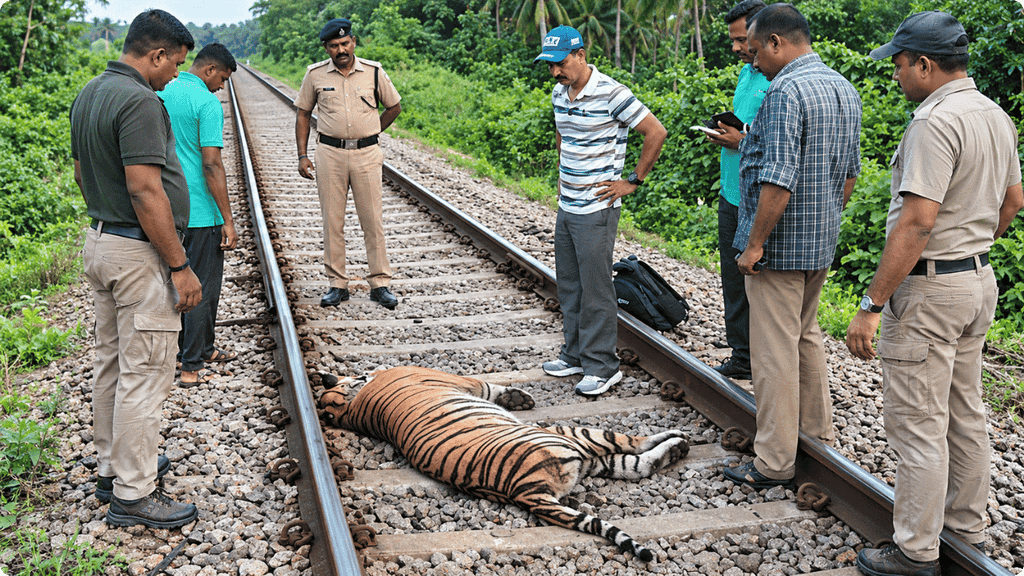
The train was the Palaruvi Express, reported as travelling from Palakkad towards Thoothukudi. Its locomotive crew reported the collision, and railway authorities alerted the forest department. Officers subsequently inspected the track and recovered the tiger’s body.
| Confirmed or reported detail | What is known |
|---|---|
| Date | 4 November 2026 |
| Animal | Male tiger, estimated four to five years old |
| Location | Sengottai-area railway stretch, Tenkasi district, near Kerala |
| Train | Palaruvi Express |
| Fatal injuries | Severe head and skull trauma identified in the postmortem |
| Reported dragging distance | Approximately 50 metres, according to preliminary findings reported by The Times of India |
| Proposed response | Reduce night-time speed limit from 60 to 30 km/h |
An unusual death does not mean an empty landscape
District Forest Officer R. Rajmohan described the collision as apparently the first recorded tiger death from a train strike in Tamil Nadu. He also said the relevant track section had not previously seen major wildlife fatalities, including elephant deaths.
That history matters. It would be misleading to describe the site as a documented tiger-collision hotspot if officials have no such record. But the reverse assumption is also dangerous: a place does not become habitat only after an animal has been killed there.
The Western Ghats landscape spans forest, plantations, agricultural areas, settlements and transport lines. Animals do not follow the administrative edges of a reserve. A tiger may move through land that looks ordinary to passengers and still be passing between areas important for shelter, prey or dispersal.
Early reports suggested the animal emerged from a mango grove near a residential area before attempting to cross the railway track. That account is preliminary, not a completed reconstruction. It nevertheless illustrates the landscape problem. A tiger can be outside a formally protected forest and still be using a route that deserves conservation attention.
Where did the tiger come from?
Forest officials said they intended to examine whether the animal had arrived from the Kerala side of the border. Rajmohan indicated that a team would review available CCTV footage in neighbouring Kerala, which lies about a kilometre from the Sengottai tiger train collision site.
That inquiry should be kept separate from certainty about the animal’s origin. The tiger has been described as a male of roughly four to five years, but there is no publicly established identification tying it to a specific reserve, territory or known camera-trap record in the reports reviewed for this article.
NDTV reported an official estimate of six or seven tigers in the wider area. That is an estimate, not a census and not evidence that this animal belonged to a particular population. The difference matters because a conservation response should be based on verified movement data, not a reassuringly precise-sounding number.
If camera traps, track evidence or other records establish a frequently used crossing, the discussion becomes more specific. Officials could map the actual approach routes and identify where warning systems, fencing that guides animals towards safe passages, or other measures might work.
The forest department wants trains slowed at night
The most important development since the death is a formal request. Rajmohan told The New Indian Express that he had written to the Railways seeking to reduce the night-time limit from 60 km/h to 30 km/h on the relevant stretch. He also said forest staff had been instructed to patrol it at night.
| Measure | Status as of 6 November 2026 |
|---|---|
| 60 km/h night limit | Reported existing limit |
| 30 km/h night limit | Requested, not confirmed implemented |
| Regular night patrols | Directed by forest officials |
| Forest offence case | Registered; circumstances under investigation |
| Cross-border camera review | Described as an intended investigative step |
A slower train can give its driver more time to react and may lower collision risk or impact severity under some conditions. That is a reasonable basis for examining speed restrictions. It is not proof that 30 km/h would have prevented this particular death. Visibility, track geometry, the animal’s behaviour and the driver’s sightline all matter.
The crucial administrative question is simple: Will the Railways accept the requested limit, for which exact kilometres, during which hours, and from what date? Until there is a response, an announced proposal should not be presented as a safety improvement already delivered.

Night patrols cannot watch every crossing
Forest patrols can find signs of movement, warn communities, gather observations and identify emerging trouble spots. They may improve coordination with railway officials, especially where a tiger’s presence is unexpected.
But a patrol is not a physical barrier between a train and an animal. Nor can personnel reliably stand at every approach to a long railway corridor each night. A meaningful response requires the forest and railway departments to share information about animal sightings, track sections with restricted visibility, and realistic preventive options.
That could include a joint inspection in daylight and darkness, mapping of recent camera-trap records, a documented process for urgent warnings to locomotive crews, and periodic review of wildlife encounters. Where engineering conditions permit, officials could evaluate crossings or vegetation management without assuming that one intervention fits every site.
The postmortem answered one question
The forest department conducted an autopsy with representatives linked to the National Tiger Conservation Authority and the chief wildlife warden present, according to The New Indian Express. Veterinary officers examined the carcass, and the proceedings were documented. The animal was cremated at the site after the examination.
Officials identified severe trauma to the head. NDTV quoted Rajmohan describing damage to the skull and brain and attributing the death to the train impact. Those findings establish the mechanism of death far more reliably than photographs circulating from the scene.
They do not establish everything about how the animal reached the track or what the locomotive crew could see. A forest offence case has reportedly been registered, but that administrative step should not be confused with a finding of criminal wrongdoing by any identified person.
A transparent final account should distinguish the veterinary findings, the locomotive crew’s account, site observations and any independent records. If those sources disagree, the disagreement is part of the story rather than something to smooth away.
The missing information is operational
After the Sengottai tiger train collision, public attention naturally concentrates on the animal. But the actionable questions mostly concern infrastructure and responsibility.
The Railways should be asked what speed restriction applied at the precise collision point, whether train data confirm compliance, what visibility conditions the crew encountered, and whether the route had any existing wildlife alerts.
The forest department should be asked whether recent tiger movement had been recorded near the track, whether any specific crossing was already known, how wildlife sightings reach railway control, and what evidence would justify permanent restrictions or engineering work.
Both agencies should make clear whether a joint review will be published. Without that, the incident risks generating a flurry of statements and very little that can be measured six months later.
This is not an argument to blame a driver or a forest guard before the evidence exists. It is an argument against allowing an investigation to stop after identifying the immediate cause of death.
What should happen next
Three results would make the inquiry into the Sengottai tiger train collision meaningful: a published finding on the circumstances; a clear railway decision on the 30 km/h night proposal and a joint, evidence-based assessment of where wildlife actually crosses this section of the Western Ghats rail network.
None requires officials to pretend they know the answer before the investigation is complete. All require them to ask more than whether the tiger was on the tracks.
The tiger is dead. The proposed speed limit is still a proposal. The test now is whether the next animal to approach that railway line encounters a safer system, or merely the same one with a new incident report attached.
Pets News Network is India’s first dedicated media platform for the pet and animal industry. For breaking global pet news, brand coverage, and advertising enquiries, contact: info@petsnewsnetwork.com