
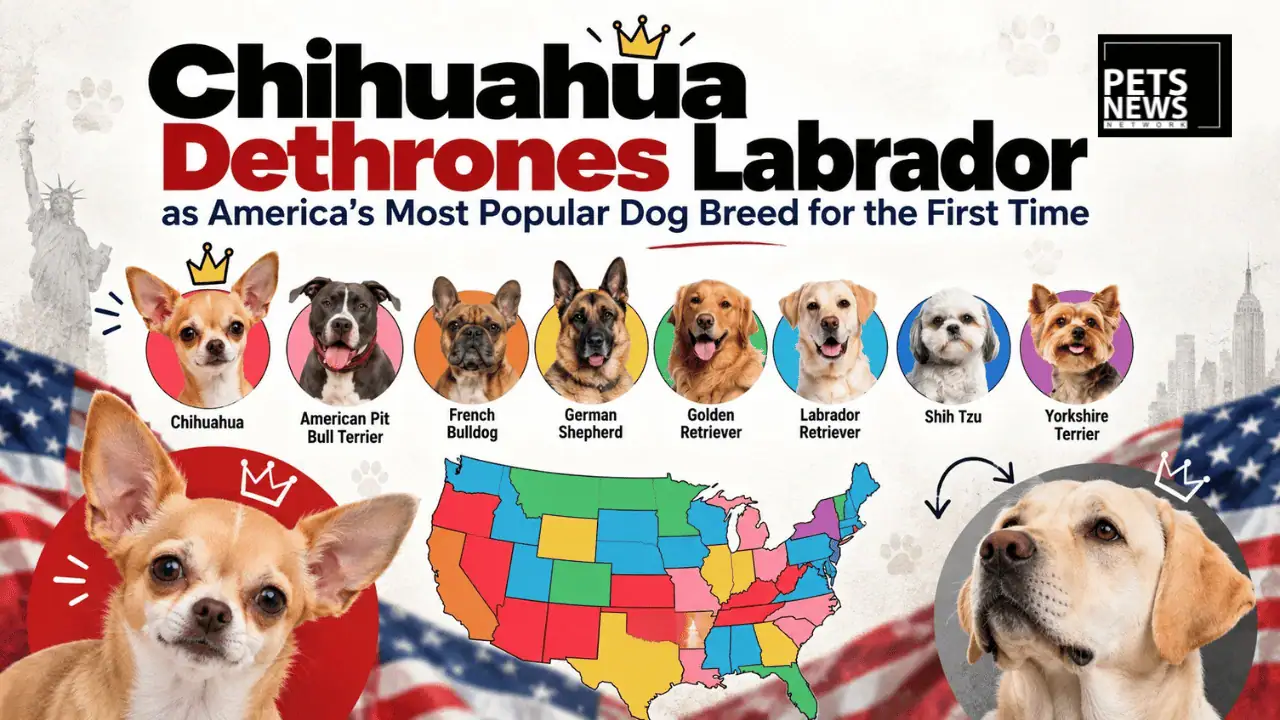

A New King Takes the Throne
For years, America’s dog breed hierarchy felt almost fixed, Labrador Retrievers and Golden Retrievers reliably occupying the top spots, decade after decade. That stability has just been upended. According to a new U.S. News & World Report study, the Chihuahua has officially become the most popular dog breed in the United States, dethroning the Labrador Retriever for the first time.
The findings are based on an unusually large and specific dataset: over 3.5 million pet insurance data points collected between 2022 and mid-2026, giving the study a genuinely robust foundation compared to more anecdotal breed popularity surveys. Notably, the report’s release was timed just ahead of National Dog Day on August 26, giving the findings an extra wave of public attention right as the news broke.
To put the scale of this shift in perspective, it helps to remember just how dominant Labradors have historically been. The breed has held the American Kennel Club’s top spot for roughly three decades running, a run so long it became something of a running joke among dog lovers that nothing would ever unseat it. This particular study measures things differently than the AKC does, but even accounting for methodology differences, a Chihuahua overtaking a Labrador at all represents a genuinely rare moment in American dog culture.
The New Top 10, and Just How Much Shuffled
The shakeup extends well beyond the top spot alone. Here’s how the full national top 10 now stacks up:
- Chihuahua — up from #2
- French Bulldog — climbed back from #6 to reclaim its 2024 position
- Labrador Retriever — dropped from #1
- Yorkshire Terrier — jumped from #9
- Shih Tzu — climbed from #8
- Golden Retriever — dropped out of the top 3 for the first time since 2024
- German Shepherd — fell out of the top 5
- American Pit Bull Terrier — dropped back down after briefly hitting #4 in 2025
- Goldendoodle — slipped from #7
- Dachshund — held steady at #10
The scale of movement here is notable. Four of the top five breeds changed position, and two toy breeds, the Yorkshire Terrier and Shih Tzu, made dramatic jumps of five and three spots respectively. Meanwhile, both retriever breeds that have long defined “classic American dog” imagery, the Labrador and Golden, slid down the rankings simultaneously.
It’s also worth noting how volatile the middle of this list has become year over year. The American Pit Bull Terrier’s trajectory alone tells an interesting story, it briefly climbed as high as #4 in last year’s report before falling back to #8 this year, a swing large enough to suggest that breed rankings outside the very top few positions can shift substantially from one year to the next, rather than settling into any kind of stable, predictable order.
Chihuahua’s Reach: More Than Just a National Win
The Chihuahua’s rise isn’t just a narrow national statistic, it reflects genuine, widespread regional dominance. The breed claimed the #1 spot in 13 individual states, including Texas, Arizona, North Carolina, and Oregon, a geographic spread that cuts across very different regional dog-ownership cultures, from the Southwest to the Pacific Northwest to the South.
That breadth matters. A breed topping the charts in a single region might reflect a local fad or a particularly active regional breeder network. A breed winning outright in over a quarter of all US states, spanning desert climates, humid southern states, and temperate coastal regions alike, points to something closer to a genuine, broad-based shift in what American households are choosing to bring home.

How Different Regions Tell Very Different Stories
Perhaps the most interesting part of this study isn’t the national ranking at all, it’s how dramatically breed preferences diverge once you look state by state.
Toy breed territory. In Alabama, Georgia, Louisiana, Rhode Island, and West Virginia, toy breeds completely swept the top three spots, Chihuahuas, Yorkies, and Shih Tzus dominating entirely, with no room for a single larger breed to break through. Georgia in particular offers an interesting wrinkle here, other recent regional breakdowns have shown the American Pit Bull Terrier actually topping that state’s individual rankings in past years, showing just how much these lists can shift even within a single state from one reporting cycle to the next.
Big dog country. The opposite pattern holds in Alaska, Montana, Maine, New Hampshire, Nebraska, North Dakota, and Wisconsin, where large breeds occupy all three top positions. It’s a clear regional split, colder, more rural states continuing to favor bigger, hardier dogs even as toy breeds surge nationally. The pattern makes intuitive sense: harsher climates and more rural, spread-out living arrangements tend to favor dogs bred for endurance, work, and outdoor tolerance over compact companion breeds built more for apartment living.
An unexpected coastal match. California and Hawaii, two states with about as different a geography and climate as you can find within the US, ended up sharing the exact same top three: French Bulldog at #1, Chihuahua at #2, and Golden Retriever at #3. It’s a reminder that lifestyle and urban density may shape breed preference just as much as climate does, both states have significant coastal, urban populations where smaller, apartment-friendly breeds thrive despite their very different weather patterns.
The Outliers Worth Noting
A few states broke from every expected pattern entirely:
- North Dakota stands alone as the only state with a top-three breed that doesn’t appear anywhere in the national top 10, the Afghan Hound, which tied with the Labrador Retriever for the #2 spot. It’s a genuinely unusual result, the Afghan Hound is a relatively uncommon breed nationally, making its regional prominence in this one state a real statistical curiosity.
- Vermont is the sole state where the Dachshund cracked the top three, landing at #3, a distinction no other state shares.
- 14 states excluded both the Labrador and Golden Retriever from their top three entirely, a striking break from the decades-long assumption that retrievers are simply America’s default dog.
Why This Study Differs From Other Breed Rankings
It’s worth noting that this US News & World Report ranking isn’t the only breed popularity measure out there, and it doesn’t always match others. The American Kennel Club, for instance, has ranked the French Bulldog, Labrador Retriever, and Golden Retriever as its top three for the past several years running, a notably different order than what this pet-insurance-based study found.
The difference largely comes down to methodology. The US News study is built on pet insurance data, which doesn’t capture every dog in the country, only those enrolled in insurance plans, while also treating categories like “pit bull,” “mixed breed,” and specific mix labels (such as “German Shepherd mix”) as distinct entries rather than folding them into a single parent breed category. That approach explains why the Goldendoodle, a mixed breed, was able to crack this particular top 10 despite the AKC not officially recognizing doodles as a standalone breed at all.
Separately, breed popularity surveys from other companies, like Rover’s annual report, have painted yet another picture entirely, with non-designer mixed breeds topping their own list ahead of any single purebred category. Taken together, these differing methodologies are a useful reminder that “most popular dog breed” isn’t a single, objective fact, it’s a figure that shifts considerably depending on which data source, and which counting method, you’re relying on.
A Longer-Term Shift Worth Watching
Some of the movement in this year’s rankings also reflects methodology refinements rather than a sudden shift in owner preference alone. Last year, for example, analysts had separated “Labradors” and “black Labradors” into two distinct categories, artificially splitting what should have been a single breed’s numbers. This year’s Labrador category folds labs of all colors back together, which likely affected exactly where the breed landed even before accounting for any genuine change in adoption trends.
Separately, the Dachshund’s steady climb, now firmly holding the #10 national spot and even cracking the top three in Vermont, lines up with the breed’s own recent surge in American Kennel Club registrations, which reportedly hit their highest ranking in 20 years. That’s a signal this particular trend isn’t isolated to one dataset.
Why Breed Popularity Shifts Actually Matter
Beyond simple curiosity, shifts like this one carry real implications for breeders, veterinarians, pet product companies, and shelters alike. A sudden surge in toy breed popularity, for instance, can shape everything from veterinary training priorities and product design (smaller-breed-specific food, accessories, and healthcare needs) to concerns about backyard breeding and impulse purchases driven by trending popularity rather than genuine breed research.
There’s also a welfare dimension worth flagging here. Rapid surges in any breed’s popularity have historically coincided with spikes in poorly regulated, profit-driven breeding operations trying to cash in on demand, sometimes at the expense of proper health screening and responsible breeding practices. As toy breeds and French Bulldogs in particular continue climbing these rankings, animal welfare advocates will likely be watching closely for any corresponding rise in health issues tied to popularity-driven overbreeding, a pattern that’s affected in-demand breeds before.
For prospective dog owners, rankings like these are best treated as a snapshot of current trends rather than a recommendation. A breed’s popularity says little about whether it’s actually the right fit for any individual household, temperament, exercise needs, grooming demands, and living situation still matter far more than what’s currently topping a national list.
What This Means Going Forward
Whether the Chihuahua’s reign at the top proves to be a lasting shift or a temporary blip remains to be seen. But the sheer scale of movement in this year’s rankings, essentially half the top five changing position, and both retriever breeds sliding down simultaneously, suggests America’s relationship with dog breeds may be entering a genuinely different phase, one where smaller, apartment-friendly, and low-maintenance-coated breeds are steadily gaining ground against the large, family-oriented breeds that have defined American dog ownership for generations.
Pets News Network is India’s first dedicated media platform for the pet and animal industry. For breaking global pet news, brand coverage, and advertising enquiries, contact: info@petsnewsnetwork.com