

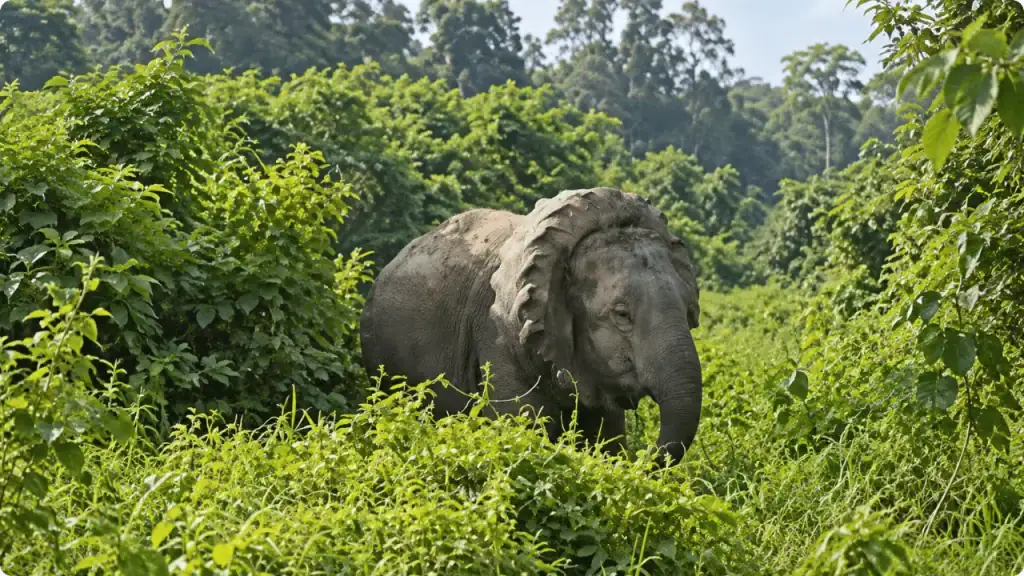
Sometime in the early hours of September 10, 2026, a wild elephant was spotted near a tea garden in the Morongi area of Assam’s Golaghat district, moving in search of food with something that shouldn’t have been there: a large tractor tyre, tightly lodged around its neck.
By the time the sun set that evening, after hours of careful monitoring, planning, and a delicate tranquilisation, the elephant walked free of the tyre entirely, unharmed. The rescue offers both a genuine story of frontline dedication and a sobering reminder of just how much danger discarded human waste can pose to wildlife living at the edges of Assam’s forests.
How the Alert Reached the Right People
The elephant was first noticed in the Bokial forest block of the Morongi area, a region that has seen repeated incidents of human-elephant conflict in the past. Local residents who spotted the animal alerted authorities, and Khumtai MLA Mrinal Saikia, upon learning of the distressed elephant, escalated the matter directly to senior forest department officials.
That escalation set the rescue in motion. A forest team was dispatched to assess the situation and begin planning a safe intervention, working alongside a specialised rescue unit from the Centre for Wildlife Rehabilitation and Conservation (CWRC) in Kaziranga, with additional support from the Golaghat Forest Division and local community members who assisted on the ground.
Patience Before Action
What stands out about this particular rescue is the deliberate, unhurried approach the team took before intervening directly. Rather than rushing to tranquilise the elephant the moment it was located, forest personnel spent the day monitoring the animal and carefully assessing its condition, tracking its movements and behaviour to determine the safest possible moment and method for intervention.
That patience reflects the genuine risk involved in any operation requiring the tranquilisation of a wild elephant. Elephants are massive, powerful animals, and a poorly timed or poorly executed tranquilisation can pose serious danger both to the animal, particularly if it collapses awkwardly or becomes disoriented near hazardous terrain, and to the rescue personnel working in close proximity during the process.
The Rescue Itself
By evening, after a full day of tracking and assessment, the team made their move. The distressed elephant was chemically immobilised, tranquilised to allow rescuers to approach safely. With what multiple accounts describe as extreme caution, the team then worked to cut and remove the heavy tyre from around the elephant’s neck.
The operation succeeded without causing any injury to the animal. According to officials, the elephant did not suffer any harm throughout the process, a genuinely positive outcome given how easily an operation of this nature could have gone differently, whether through complications during tranquilisation or difficulty safely removing an object as unwieldy and tightly lodged as a large tractor tyre.
The Minister’s Response
Assam Environment and Forests Minister Jayanta Malla Baruah shared details of the operation directly on X, praising the team’s work in real time as the rescue unfolded. “Upon receiving information about a wild elephant roaming in the Morongi area of Golaghat District with a large tyre stuck around its neck, our Forest Department teams immediately swung into action,” Baruah wrote.
Cases like this one carry significance well beyond the individual elephant involved. They spotlight an increasingly common, entirely preventable hazard facing wildlife living near human settlements and agricultural land across India: discarded waste, tyres, plastic, abandoned machinery parts, left near forest borders, tea estates, and farmland edges, precisely the kind of terrain elephants regularly move through in search of food and water.
He continued: “Our frontline teams undertook the rescue operation with utmost care and caution. Every effort is being made to safely free the elephant while ensuring the safety of both the animal and our personnel. I appreciate the prompt response, courage and dedicated efforts of our frontline forest teams. Their commitment to protect our wildlife, even in challenging circumstances, is truly commendable.”
Assam Chief Minister Himanta Biswa Sarma also praised the team’s swift action, adding further political weight to what was already a widely shared, well-received rescue story across Assam’s media landscape and social platforms.
Why This Story Resonates Beyond a Single Rescue
A tyre might seem like an unlikely trap for an animal as large as an elephant, but curious or foraging elephants can end up with debris caught around limbs, trunks, or necks with alarming regularity across India’s forest-adjacent regions. Once lodged, such objects can cause severe distress, restrict movement or breathing, and in the case of tighter-fitting debris, potentially cause injury or infection the longer it remains stuck.
The Morongi area’s own history of human-elephant conflict adds another layer of context here. Regions where elephant corridors intersect closely with tea gardens, farmland, and settlements already face heightened tension between human activity and elephant movement. Incidents like this one, where human-discarded waste directly endangers an elephant navigating that same shared landscape, only add to the complexity of managing that coexistence safely for both people and animals.
The Institutions Behind the Rescue
This operation also highlights the value of well-coordinated wildlife rescue infrastructure in Assam specifically. The Centre for Wildlife Rehabilitation and Conservation in Kaziranga has built a strong reputation for exactly this kind of specialised, high-risk wildlife intervention work, and its direct involvement alongside the Golaghat Forest Division reflects the kind of institutional collaboration that makes operations like this achievable safely.
Equally important was the role played by ordinary residents and local elected representatives in surfacing the issue quickly. Without local awareness and a prompt alert reaching the right officials, an elephant in this kind of distress could have gone unnoticed for far longer, worsening its condition and reducing the odds of the kind of clean, injury-free rescue this operation achieved.
A Reminder Worth Repeating
Beyond celebrating a successful rescue, this incident serves as a genuine call to action for communities living near forest edges and elephant corridors across Assam and beyond. Proper disposal of tyres, machinery parts, and other bulky waste near forest boundaries isn’t simply a matter of tidiness, it’s a direct, practical safeguard against exactly the kind of entrapment this elephant experienced.
As human and elephant habitats continue overlapping across Assam’s tea-growing districts and agricultural belts, incidents like the Morongi rescue are likely to keep recurring in some form, unless waste management practices near these ecologically sensitive borders improve meaningfully. For now, though, this particular story has a genuinely happy ending: a distressed elephant, a coordinated team of forest officials and wildlife rescuers, and hours of careful, patient work that ended with the animal walking free, tyre-free, and unharmed.
Pets News Network is India’s first dedicated media platform for the pet and animal industry. For breaking global pet news, brand coverage, and advertising enquiries, contact: info@petsnewsnetwork.com