


A Second Milestone for India’s Rarest Desert Cat
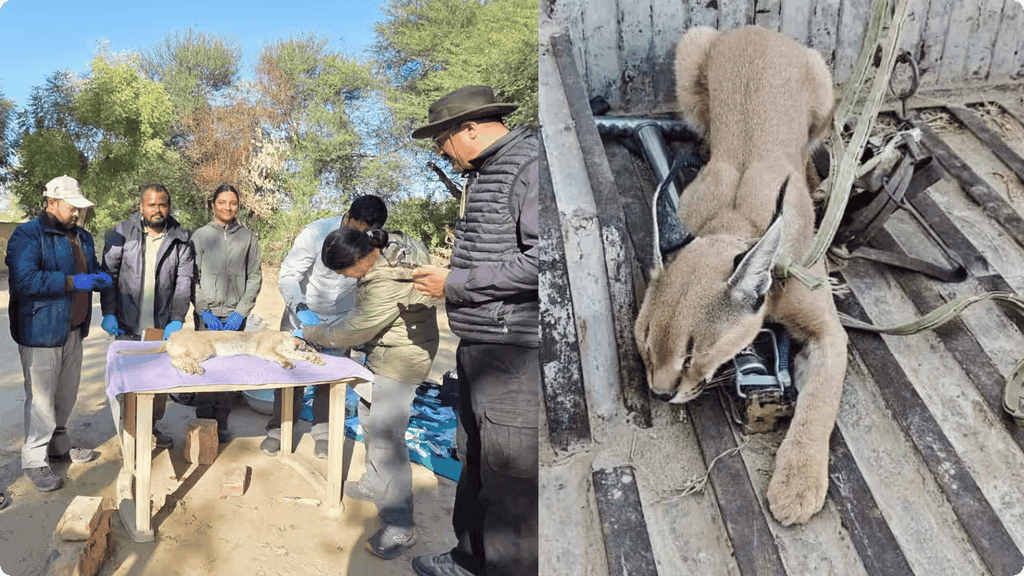
The Rajasthan Forest Department, working alongside experts from the Wildlife Institute of India (WII), has successfully released a rare, endangered female caracal back into her natural desert habitat in Jaisalmer after a full medical recovery. Before her release, the wild cat was fitted with a tracking radio collar, marking only the second time in India that a caracal has been radio-collared and released into the wild. The first was a male caracal collared in the Shahgarh area of Jaisalmer in January 2026.
Together, the two collarings represent the beginning of what wildlife officials hope will become a sustained, data-driven effort to understand and protect one of India’s most elusive wild cat species, in the very desert landscape where scientific monitoring of the species had lapsed for years before this recent push.
How the Rescue Unfolded
The story behind this particular caracal’s release began on September 1, when local villagers in the border areas of Jaisalmer spotted the wild cat in a visibly weakened state. Rather than leaving the animal to fend for itself or attempting to handle the situation on their own, the villagers immediately reported the sighting to the Forest Department, a decision that wildlife experts say was critical to the cat’s survival.
Forest officials and wildlife experts responded quickly, safely rescuing the animal and beginning a sustained rehabilitation effort. The caracal received round-the-clock monitoring and veterinary treatment over the following weeks, with her condition tracked closely until she was declared fully fit to survive independently in the wild. Only once that threshold was met did officials proceed with fitting her with a radio collar and returning her to her natural habitat in the Ramgarh landscape of Jaisalmer, the same broader desert region where the earlier male caracal was collared and released.
Why the Radio Collar Matters
A radio collar does far more than simply track an animal’s location. For a species as poorly studied in India as the caracal, it represents a rare opportunity to build a genuine, data-backed understanding of how the animal actually lives in the wild.
The Forest Department has confirmed it will conduct intensive scientific tracking of the released female, combining radio-collar GPS data with observations from camera traps already installed across the region. Together, these tools are expected to generate a much richer picture of the species than has previously been available in India.
Specifically, the research project aims to study:
- The caracal’s home range and how far it travels within its territory
- Habitat usage patterns across the arid desert landscape
- Hunting and prey preferences in a resource-scarce environment
- Movement patterns over time, including seasonal shifts
- General behaviour, offering insight into a species that has historically been extremely difficult to observe directly
This kind of granular, longitudinal data was essentially unavailable for Indian caracals before the January 2026 collaring of the male individual. With a second collared caracal now contributing data from the same broader landscape, researchers stand to gain a comparative picture, a rare chance to understand how the species behaves across more than a single case.
Why the Caracal Matters to the Desert Ecosystem
Caracals occupy a critical ecological role in the Thar desert landscape as one of the region’s top small predators. Their presence in an ecosystem is often read by conservationists as a signal of broader ecological health, since predator species sitting near the top of a food chain typically require a stable, sufficiently intact prey base and habitat to survive.
By keeping populations of smaller desert species in check, caracals help maintain the broader biodiversity and ecological balance of the arid landscape they inhabit. Their decline or disappearance from a region, conversely, can be an early indicator of broader habitat stress or degradation. That makes monitoring efforts like this radio-collaring project valuable well beyond the fate of any single animal, they offer a window into the health of the desert ecosystem more broadly.
Community Vigilance as a Conservation Tool
Wildlife experts involved in the rescue have emphasised that the swift action taken by local villagers was instrumental to the caracal’s survival. Had the animal gone unreported, in a weakened state and in a remote border region, its chances of survival, let alone recovery and eventual release, would likely have been significantly lower.
This case is being held up as a clear example of how community participation and habitat conservation go hand-in-hand. In a landscape as vast and sparsely monitored as the Thar desert’s border regions, official forest patrols and camera traps can only cover so much ground. Alert, informed local communities effectively extend the reach of conservation efforts, often serving as the first and most critical line of detection for animals in distress.
Building on a Fragile Comeback
The caracal’s presence in Rajasthan’s desert regions has itself been part of a broader, closely watched conservation story in recent years. The species, sometimes referred to by its Hindi name siyahgosh, had become so rare in India that confirmed sightings were treated as significant events in their own right, with reports of caracals being spotted in areas like Ramgarh and even, in some cases, in entirely new locations such as the Mukundra Hills Tiger Reserve drawing considerable attention from wildlife researchers and media alike.
Against that backdrop, a second successful radio-collaring in under a year represents meaningful forward motion, not just for this individual animal’s survival, but for the broader project of understanding exactly how many caracals remain in India’s desert landscapes, where they live, and what they need to persist.
What Comes Next
With two caracals now radio-collared and being tracked in the Jaisalmer region, the Forest Department and WII researchers have a genuine opportunity to begin comparing data across sexes and individual home ranges, something not previously possible for this species in India. The insights gathered from GPS tracking and camera trap data over the coming months are expected to directly inform future conservation strategy, habitat management decisions, and efforts to reduce human-wildlife conflict in the areas where caracals and local communities share the same terrain.
For now, the female caracal’s return to the wild in the Ramgarh landscape stands as both a individual success story and a small but meaningful step toward closing a long-standing knowledge gap about one of India’s rarest wild cats.
Pets News Network is India’s first dedicated media platform for the pet and animal industry. For breaking global pet news, brand coverage, and advertising enquiries, contact: info@petsnewsnetwork.com